What is SMB1001? A guide to cybersecurity certification for Australian businesses
With the Australian Signals Directorate (ASD) recently announcing the evolution of the Essential Eight into ASD Essentials, many Australian businesses may be wondering what this means for their cybersecurity requirements, and which frameworks or standards are right for them.
While ASD Essentials provides important guidance for strengthening cybersecurity, another standard is gaining attention among small and medium businesses: SMB1001.
Developed specifically for small to medium businesses, SMB1001 offers a practical, structured approach to improving cybersecurity, with a clear pathway towards recognised certification. Importantly, it also helps business owners and directors demonstrate that they’re taking reasonable steps to protect their organisation’s systems and information.
So, what is SMB1001, how does it work, and why should your business consider it?
What is SMB1001?
SMB1001 is a cybersecurity standard developed specifically for small and medium businesses, particularly organisations with fewer than 200 employees that may not have dedicated internal cybersecurity teams.
Developed by Dynamic Standards International (DSI), with input from an industry steering committee that includes organisations such as the Australian Signals Directorate (ASD) and Council of Small Business Organisations Australia (COSBOA), the standard is designed to make cybersecurity more accessible and achievable.
It has also gained support from professional bodies, including the Queensland Law Society, which recognises its value in helping smaller organisations protect sensitive information and demonstrate cybersecurity due diligence.
SMB1001 provides a framework for assessing and improving cybersecurity across important areas such as device and network security, access management, backup and recovery, policies and procedures, and staff awareness.
The standard offers five progressive certification levels, allowing businesses to strengthen their security over time rather than attempting to implement everything at once.
How does SMB1001 certification work?
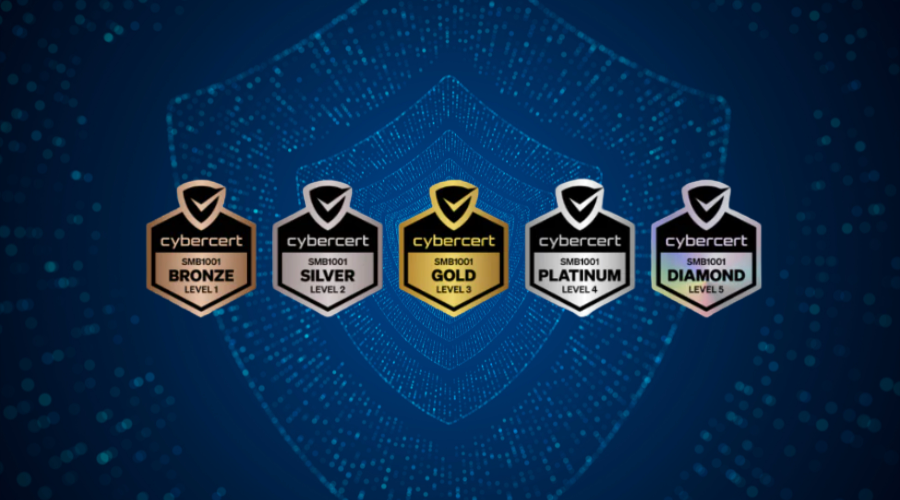
SMB1001 has five certification levels, each building on the requirements of the previous level.
- Bronze – Level 1: Getting the basics right: Establishes fundamental cybersecurity protections, including firewalls, antivirus software, software updates, password security and backups.
- Silver – Level 2: Strengthening everyday security: Builds on those foundations with stronger account management, multi-factor authentication and other measures to protect business systems and information.
- Gold – Level 3: Taking a more comprehensive approach: Introduces broader cybersecurity requirements, including formal policies, asset management, incident response planning and more advanced security controls.
- Platinum – Level 4: Independent assurance: Adds more comprehensive security measures and independent verification that the organisation meets the required controls.
- Diamond – Level 5: Advanced cybersecurity maturity: The highest certification level, incorporating more extensive security, governance and assurance requirements.
Businesses can pursue a level appropriate to their size, risk profile and customer requirements, then progressively work towards higher certification as their needs evolve.
An important distinction is that Bronze, Silver and Gold certifications are based on formal director attestation, while Platinum and Diamond require independent external verification.
Why should businesses consider SMB1001?
For many small and medium businesses, cybersecurity can feel like an ongoing list of technical recommendations, without a clear understanding of what’s been achieved or what should come next.
But cybersecurity isn’t just an IT responsibility. Business owners and directors are increasingly expected to understand and oversee cyber risk, particularly when it comes to protecting sensitive information, maintaining business continuity and meeting client or contractual requirements.
SMB1001 provides a structured, evidence-based approach, helping businesses to:
- Demonstrate director accountability: Establish a documented record of cybersecurity controls and improvements, supporting directors in demonstrating that reasonable steps are being taken to protect business information.
- Understand and prioritise cyber risks: Assess existing protections against defined requirements and identify where improvements are needed.
- Meet client, insurer and stakeholder expectations: Provide evidence of cybersecurity maturity to customers, business partners, insurers and other stakeholders who increasingly expect organisations to demonstrate appropriate security measures.
- Build confidence in existing protections: Establish important security controls across people, processes and technology, rather than relying on technical solutions alone.
- Demonstrate ongoing improvement: Work towards recognised certification through a progressive, achievable pathway.
Under the SMB1001:2026 standard, Gold certification involves 27 cybersecurity controls, covering areas such as endpoint protection, incident response planning and asset management.
Importantly, certification doesn’t guarantee that a business will never experience a cyber incident or automatically satisfy every legal obligation. It provides a clear framework for demonstrating that defined security measures are in place, supported by documented evidence and ongoing improvement.
How does SMB1001 compare to ASD Essentials and ISO 27001?
SMB1001 is one of several cybersecurity frameworks and standards available to Australian businesses.
The Australian Signals Directorate’s Essential Eight, now evolving into ASD Essentials, provides guidance for strengthening technical cybersecurity protections across different technology environments.
ISO/IEC 27001 takes a broader approach to information security governance, requiring organisations to establish and continually improve a formal Information Security Management System.
SMB1001 provides another option, particularly for businesses seeking a practical, progressive approach to cybersecurity improvement and certification without the complexity of a full ISO 27001 implementation.
These approaches aren’t mutually exclusive. Many cybersecurity controls overlap, and improvements made under one framework can contribute to another.
The right approach depends on your organisation’s size, risks, industry and business requirements, and we can help you determine the best approach for your organisation.
Ready to uplift your organisation to the SMB1001 Gold standard?
Veracity currently holds SMB1001 Gold certification and is progressing towards Platinum, building on our experience supporting Australian organisations with Essential Eight maturity, ISO 27001 and broader cybersecurity governance.
We can help your organisation assess its current security position against the SMB1001 requirements, identify gaps and implement the technical and organisational improvements needed to work towards Gold certification.


